Wednesday, December 15, 2010

KAWAH DOMAS HIKE - Pit Stops 1-6

FAUNA, FLORA AND MORE


PIT STOPS 1-6


Our Hike To Kawah Domas Pit Stops

I am blogging my hike with 25 Pit stops and will post at intervals. I had to rewrite all pit stops after three days of getting all my information organised but the blog hanged and deleted my entry. I am not giving up and surging forward to post all pit stops again here.


Pit Stop 1: Tourist Information Office


The trek begins at Tourist Information Office

Terraced steps to aid your safe trek

We took the shorter hike to Kawah Domas than the longer Kawah Ratu journey. The testing of your feet and endurance began at the Tourist Information Office and ended at the crater. Three guides were assigned to us. Pak Rizki, Pak Daha and Pak Didi introduced themselves proudly as 'Orang Hutan' or the Forest People.

The three gentlemen came with a fees of RP 300 000. They are very familiar with everything found in the forest like the back of their hands. We were fortunate to amass ourselves with a lot of information about the the fauna, flora and everything nature that we came across during the two hour hike. It was simply a multi-sensory experiential learning lesson I would be proud of to conduct for my students. This time round, I was a student and they, my mentors. They were instrumental in adding value to our hike and enriching it with golden nuggets and learning takeaways to an otherwise ordinary touristic hike.


Pit Stop 2: The Black Forest

The Black Forest of Jambu Alas trees greet us


The Peace Tree. The trunks shows the two-finger peace sign


The Blacks Forest with its twisted trunks and gnarled looking hands

The black tree trunk tress with equally dark coloured burnt spread-out branches were the opening scene of the walk. The gnarled and armed-like branches seem to welcome us for a good hike. My husband's thought otherwise. The trunks according to him were screaming for help to save them because of the extreme temperatures they had been forced to endure.

If your imagination is wild and fertile, like mine, the trees may look and take the form of many interesting shapes. I saw a bear's face, a mother holding her child, an emu emerging from the rocky ground and even ghostly appearances of extra-terrestrial beings.

After descending some steps, Pak Rizki mentioned that the Jambu Alas trees had transformed to that state due to Mt Tangkuban Prahu eruptions. The heat, ashes and smoke had 'toasted and scalded' those trees to what they are now. Yet, they are still standing strong and surviving for more years to come. Their resilience and tenacity to stand upright in an environment of uncertainty was a lesson for me.


Pit Stop 3: The Changing Temperature


The refreshing air was good for the lungs


Pak Riziki was our chief guide


Pak Daha and Pak Didi helped us along the way


It began to get cooler as we hiked further down. Temperature could easily reach 18-22 degrees Celsius. The vegetation got thicker and at certain routes, the branches of the Black Forest interlocked forming an umbrella above us. That made the hike more enduring and pleasant as the cool air enveloped us.

Ferns acting as ground cover and mosses as rock caps are becoming more evident. According to Pak Riziki, the area receives exceptionally high amount of moisture during the 'Ber' months. I did a quick mental check and knew what he meant. Come September, October, November and December the meteorological station will record high amount of rainfall received. We were lucky it did not rain that day and was blessed with an air-conditioned room temperature.

At above 2076m above sea-level, it is an ideal elevation for a leisurely hike for urbanites like me who seldom succumbs to the thrice weekly exercise regime. The relief was gentle here and I was looking forward to more exciting new discoveries along the way.

Pit Stop 4: The Exotic Batik Design


The youth shaving off the Parkis plant bark


The eye-catching motif on the bark
The wood shavings remind me of a tiger stripes

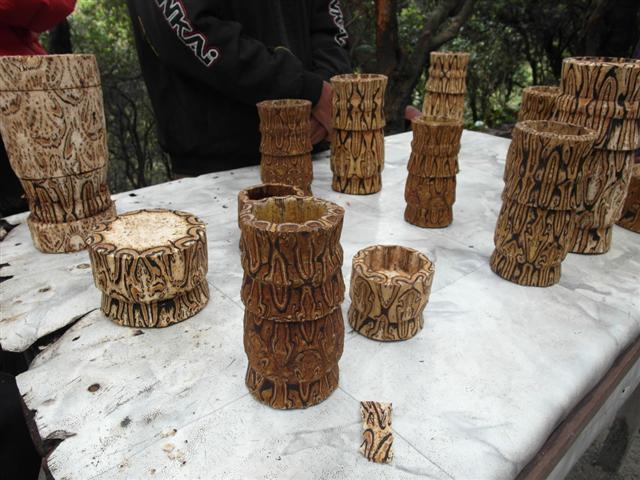
Souvenir wares for your collection


A youth was holding a bark and shaving the outer layer with his parang. The transformation on the bark to reveal the next layer was like magic to my eyes. From a plain rough looking bark, the smooth surfaced trunk now displayed complementary hues of brown, beige and cream batik-like design as if drawn by a batik artist with his tjanting tool.

We were enthralled by the unique design transformation found on the Parkis (fern) plant. Where the old frond of the fern has fallen off, the frond joint leaves behind dots, spots, lines and imprints on the bark. Once the outer layer of the bark is shaved off, it reveals an exquisite batik-looking fabric print. I picked up some wood shavings and upon closer inspection thought that the design was akin to a tiger stripes.

Taking advantage of the beautiful motif on the bark, the entrepreneurial spirited youth had set up a stall to sell his wares of ash trays and vases he had sculptured from the bark.

Pit Stop 5: Gully Your Way


The gullies with the more resistant lava bed protruding than the other rocks.
Lava once flow along this channel.


The unevenness gully bed due to the piling of lava over several eruptions


Swirling fast flowing water has contoured the rocks in the gully


Running water from heavy rains has formed gullies along the side of the trail where lava had flowed during Mt Tangkuban Prahu eruptions. The ditch-like gullies of varying depth and width have been at the mercy of forceful water flow, which has caused deep vertical erosion into its bed. Soil and rocks have been removed through corrasion, attrition, hydraulic action and solution. The eroded materials are flowed further down the hill slope while the heavier and bigger ones are constantly being eroded by the rain that meanders its way into the gullies.

I noticed the gully floor has been unevenly eroded because of the different rock composition. The more resistant rocks like basalt and granite stood out like protruding bumps while the softer clayey materials have hidden and recessed themselves further on the gully floor and sides. Rushing and swirling water has meandered its way around the tougher rocks, polishing and grinding the edges to smooth finish.

Screaming oxidised orange-coloured mica rocks emerged from the deep crevices where the softer materials have lost the water battle. Oxygen combines with iron-bearing silicate minerals has resulted in the "rusting" look of the basalt rocks. I was so fascinated to see how running water has contoured and incised the gully floor in its own natural way without any form of modern technology.


Pit Stop 6: Weathering And Erosion


A forest fairy perches on a rock that has a sheeting appearance

Basalt of different sizes strewn on the ground with the flow of rain water

A dislodged piece of rock removed from its original position

Rocks from lava flow of varying resistance. The protruded rock looks like a crocodile head to me.


Rocks of different hues and mineral composition. Lines of weakness are very clear.
White silicate in between the layers of rocks.


Biological weathering on my right side. Soil erosion has caused the tree to lose its pride and stature.


I was pleasantly surprised to note that we were actually standing on once molten rocks which have cooled and crystallised the lava flow to form plutonic igneous rocks which Mt Tankuban Prahu had emitted in 1969 and earlier. I was kicking and stepping on igneous rocks like basalt, granite, andesite and quartz. Now they have been exposed to the weather elements of erosion and biological reaction of the trees and animals. Some pieces of rocks ended up as my souvenir items as I pushed them into my jeans pocket

The gully erosion where water flows along narrow channels during a heavy torrential downpour and surface runoff turbulence have left many beautifully-layered rocks smooth and rounded in shape. The exposed surface displayed different shades, indicating the different minerals found in the rocks. The bigger boulders are mainly found at the upper part of the gully while the smaller ones have been transported to the lower part of the terrain. In no time the bigger size particles would be dislodged because of the increased elevation and gravity as more soil is washed away by rivulets and streams of water on the gully floor.

I got a feeling that the falling rain has also played a part in sheet erosion of the rocks. The water splashes on the rock surface and the particles are knocked by the raindrop impact. Rock layers are detached and peeled off in a more or less uniform manner from the rock surface. It gives the rock a layered appearance as if it has been chiselled off by an expert mason.

Roots and trees have also contributed to the biological weathering of the rocks here. They push away the materials from the soil as the roots find their way deeper in the ground. Animals burrow their home in the gound, loosening materials at the same time.


More Pit Stops Coming.....

Tuesday, December 14, 2010

MY BANDUNGLOGUE

The sign board that proclaims you have arrived at Mt Tangkuban Prahu

The Legend of Sangkuriang and the result of his fury behind me

The hike around Kawah Ratu and Kawan Domas craters begin here

Tired feet? No worry for horsey is here!


Strawberry-shaped bags for your little girls

Soft rabbit fur merchandise to tempt you


Hang these mufflers round your neck to keep the daft away

Sap, Me and Hubby striking a pose in front of the information office

Infront of the model of the area


The aerial view of the region located in the information centre
Hubby trying to balance the seo mai grobak

Breathing fresh air, expanding our lungs and getting ready for the hike
The upturned boat with the broken hull is behind us

An excellent explanation of the vulcanic activities was given by the guide (with cap)

The guide-cum masseuse told us that Kawah Domas is still opened for tourists

On fair days, the Java Sea (in the foreground) is visible from here


The aquamarine tint of water in the pool


Mud flows and eases its way into the crater


Absence of vegetation around the slope of the rocky crater


Scorched vegetation is evident around the crater's perimeter

Sulphur discharge makes the pool yellowish
A commanding panaromic view of Mt Tankuban Prahu with Kawah Ratu at its mouth

I was swallowed by the myth and nature's creation on top of Mt Tangkuban Prahu


MYTHOLOGY AND GEOLOGY


If Malaysia has 'Puteri Gunung Ledang' as its most tear-jerking legendary love story between a beautiful Javanese princess and the loyal Malaccan king warrior Hang Tuah , the Sundanese of Indonesia holds dearly to their local folklore; 'The Legend of Sangkuriang'. It tells of a forbidden love between a mother, Queen Dayang Sumbi and her own son, Sangkuriang.

On my recent holiday trip to Bandung, I made a stop-over at Mt Tangkuban Prahu. 'Tangkuban' means upside down while 'prahu' means a boat. The mountain's prominent and peculiar shape of an up-turned boat is closely linked to the Sangkuriang legend. The Sudanese's imagination and the world of fantasy had made them weave this unrequited love legend when Dayang Sumbi realised that she was about to marry her own son. All hell broke loose when Sangkuriang was tricked and did not fulfill his mother's impossible wish of making a boat and creating a lake overnight as means to stop the marriage.

Tall trees lined the road up tp the mountain park and the change of vegetation from hibiscus shrubs to pine trees due to the increasing height and lowering of temperature is a good geographical study on natural vegetation with tropical climate. The drive up to Mr Tangkuban Prahu was a reminiscence of Jurassic Park. The towering trees and their shadows took the shape of a T-Rex, Triceratops and Stegosaurus ruling the earth as our car past them. We were not walking with the dinosaurs but driving with them. Only the eerie shrill and shrieking cries of the extinct beasts was missing. Otherwise, I bet you my scream would echo and drown theirs if they had tried to tuck and lower their necks and heads through our windows to say hello to a Singaporean.

I was transported to this elevated land of mystic and taboos where spirits, geology and vulcanicity fill the area of Mt Tangkuban Prahu once the driver applied the car brakes at the park. Admission fees is RP 35 000for tourists and the locals pay RP12 000. Unless you speak and look like a local, you can expect the saving up bit. This highland region is Bandung's main draw for any tourist. It is just a 45min drive from Lembang, an agricultural and horticultural area where we stayed at Sindang Reret Resort, Cikole. The resort surrounding offers yet another spectacular spectacle and the cool fresh air is a must destination for you to spend your holidays and siphon away the accumulated stress you have had at your desk, computer and your 'I' paraphernalia: I-Phone, I-Pod and I-Pad.. As far as I am concern, I just want to get rid of my I-Bags. And don't you dare show me the I-Ron either. Switch me off from that!

Being a concrete jungle dweller like most Singaporeans, I stood awed momentarily struck by the panoramic view of the volcanic mountain of Tangkuban Prahu and its huge Kawah Ratu crater spewing dense poisonous sulphurous smoke and vapour upwards. Scorched vegetation because of the heat from the fumes could be seen at the far side of the slope with my powerful Samsung camera. Another useful equipment to bring along would be a good pair of binoculars. A saddled depression (supposedly the broken hull of the boat which Sangkuriang had kicked) also caught my eyes where two peaks were sandwiched between a low valley in front of me. Scanning the surrounding with my eyes flirting and consuming the 360 degrees view hungrily, I had a reality jolt where folktales, endearing love stories and magic can still stand side by side with nature and her creation of volcanoes, craters and igneous activities

With my camera strap securely twined round my wrist, I peered at Kawah Ratu below the 2076m from where we had parked the car. Like a one-armed bandit, my camera went clicking away non-stop at the pebbles and rocks of different sizes which had strewn the crater floor together with the smoky hazy appearance enveloping the depression. The slopes were beautifully layered with different colours and hues of grey-coloured rocks. It reminded me of my secondary days art lessons under Mrs Low on tonal value for the grey scale - from white to ashen grey to charcoal black. A pool of bluish and yellowish tint bubbling water reflected the little sunlight of the day from the base of the crater. I think Dayang Sumbi's tears upon realising that she was about to marry her own son have not dried up after all.


There were no tourists at the base of the crater so I presumed that it would be dangerous to descend to the kawah or the valley crater because of the strong stench of sulphuric smell and the poisonous gas its emitting. The odour reminded me of rotten eggs and if the air is cool, the smell becomes worse. However there are souvenir stalls and tourists trekking along the slope on horse backs leading to the kawah from a safe distance.

I was assaulted by vendors selling woolen mufflers, caps and David Crocket hats. There were those peddling colourful ninja puppets, bonsai trees as well as bags and tissue boxes made out of soft rabbit fur. I know some animal lovers would be jumping on your feet when you hear of the fur trade and rabbit satay that takes place here. Some locals ply their strawberry and raspberry punnets for sale. Horse rides are available too. Andesite necklace, bracelets and rosary sellers followed you like magnets, not wanting to let you off their eyesight every second. But they were not rude or aggressive because they were carrying their lanyard as official vendors. Any complaint from a tourist may lead to their suspension and lose of earning. I must say the vendors were politely persistent but not ruthless. It is not easy making their living up there because there are simply too many of them trying to lock a sale with the tourists. My only regret was not buying the rabbit fur merchandise and the ninja puppets as I thought that we would come back to the spot again after our Kawah Domas hike.

A model of the volcanic area is found at the information centre. Grab some brochures while there. The guide gave us a detailed explanation of the region and the eruptions that had taken place. if you are lucky, like us, you can see the Java Sea on clear days from atop the information centre. You can also spot some tea plantations among the greenery there. To get the most out of your rupiah and experience from Tangkuban Prahu, is to take an enjoyable walk around the crater. You have to part with RP 300 000 an hour for a licensed guide to bring you on your hike down. You won't be hassled by the vendors but would be thrilled by the geysers, the bubbling mud and steam of the craters that await you as a reward for your hike. And be warned, the guides would fish out their wares for you to buy before you end the trip.

Geologically, Mt. Tangkuban Perahu's eruptions and lava flows have played a pivotal role in carving the shape and landforms found on the highlands and lowlands around the area. Basalt, andesite, tufa and batu apung have hardened due to the numerous eruptions over a century. The locals have a lot of medical and beauty use for these stones. Mudflows which now have formed into a mass fan out the terrain. Rivers have sculptured the river bed through erosional processes like corrasion, attrition, solution and hydraulic action and exposed the oxidised rocks to bright colours like orange and red. Waterfalls from cliffs and resistant rocks add more charm to the place

Like a woman whom you never can trust her mood and predict her feelings accurately, Kawah Ratu or the Qeeen Crater has dsplayed her furore and threats through many seismic activities. Her first eruption was in 1846. A major eruption took place in 1969 where it spewed ashes and steam 500m high in an outburst of anger. In 1992 it sent vulcanololgists scurrying to fear for another eruption because of its unususal seismic readings.

I learnt from my guide that there are eight parasitic craters but only four main craters are famous, with Kawah Ratu being the biggest. New kawahs have resulted over the years in the northern flank of the mountainous region. There are also the Kawah Baru and Kawah Domas. The oldest one is Kawah Upas. If you are a bird lover and wish to take your flight of fantasy, head for Kawah Putrh. It is a sanctuary for over 1000 birds.. Arm yourself with a pair of binoculars for you to do your annotaiton. The bird ensemble orchestra heightens at dusk.

I had an exhilarating moment hiking to Kawah Domas with three local Sudanese who called themselves proudly as Orang Hutan.

Wait for the next blog entry on my fauna and flora lessons from my Orang Hutan guides as we hiked all the way to Kawah Domas.


THE LEGEND OF SANGKURIANG

According to the legend, Sangkuriang had been separated from his mother, Dayang Sumbi, as a child. Yet he was destined to meet his mother again. On his way home, he stopped at a small village and met and felt in love with a beautiful girl. He didn't realise that the village was his homeland and the beautiful girl was his own mother. Dayang Sumbi had been besgowed by the gods with eternal youth. They fell in love and made plans to marry.

One day before the planned wedding, Dayang Sumbi saw and recognized a scar on Sangkuriang's head. She suddenly realized that she had fallen in love with her own son who had left her twenty years previously. She was horrified and realized she could not marry her own son. She revealed the whole truth to Sangkuriang and asked him to call off the wedding. But Sangkuriang didn’t believe her and insisted on going through with the wedding.

Dayang Sumbi then told Sangkuriang that she would only marry him if he could build her a great lake by filling the whole valley with water. She said he must also build a boat for them to sail in, and both of these tasks must be completed in one night. Sangkuriang accepted the challenge. With the help of some guriangs (heavenly spirits / god in ancient Sundanese belief), he dammed the Citarum river with landslides. The river's water rose and filled the plain, transforming it into a lake. Then Sangkuriang cut down a massive tree to make a boat.

When dawn was about to break, the boat was almost complete. Dayang Sumbi realized that Sangkuriang would fulfill the conditions she had required of him. So she prayed to God to help her prevent the disgrace of a marriage between a mother and her son. With a wave of her magic shawl, Dayang Sumbi lit up the eastern horizon with flashes of light. Deceived by what looked like dawn, cockerels crowed and farmers rose for a new day. Sangkuriang thought that he had failed. In his anger, he kicked the boat that he had built and it fell, turning upside down, transformed into Mount Tangkuban Parahu (in Sundanese, "tangkuban" means "upturned" or "upside down", and "parahu" means "boat.") The wood left over from the boat became Mt. Burangrang and the rest of the huge tree became Mount Bukit Tunggul. The lake became Lake Bandung.


Watch the ending of the Sangkuriang movie.


Friday, December 3, 2010

CLOSER TO HOME

PAST & PRESENT OF SINGAPORE RIVER


Click to play this Smilebox scrapbook


SHANGHAI X'PERIENCE


Click to play this Smilebox scrapbook
Create your own scrapbook - Powered by Smilebox
This scrapbook generated with Smilebox